Mexico’s Secretary of Governance Announces Group of Experts Will Analyze National Registry of the Disappeared
This article by Néstor Jiménez originally appeared in the October 14, 2026 edition of La Jornada, Mexico’s premier left wing daily newspaper.
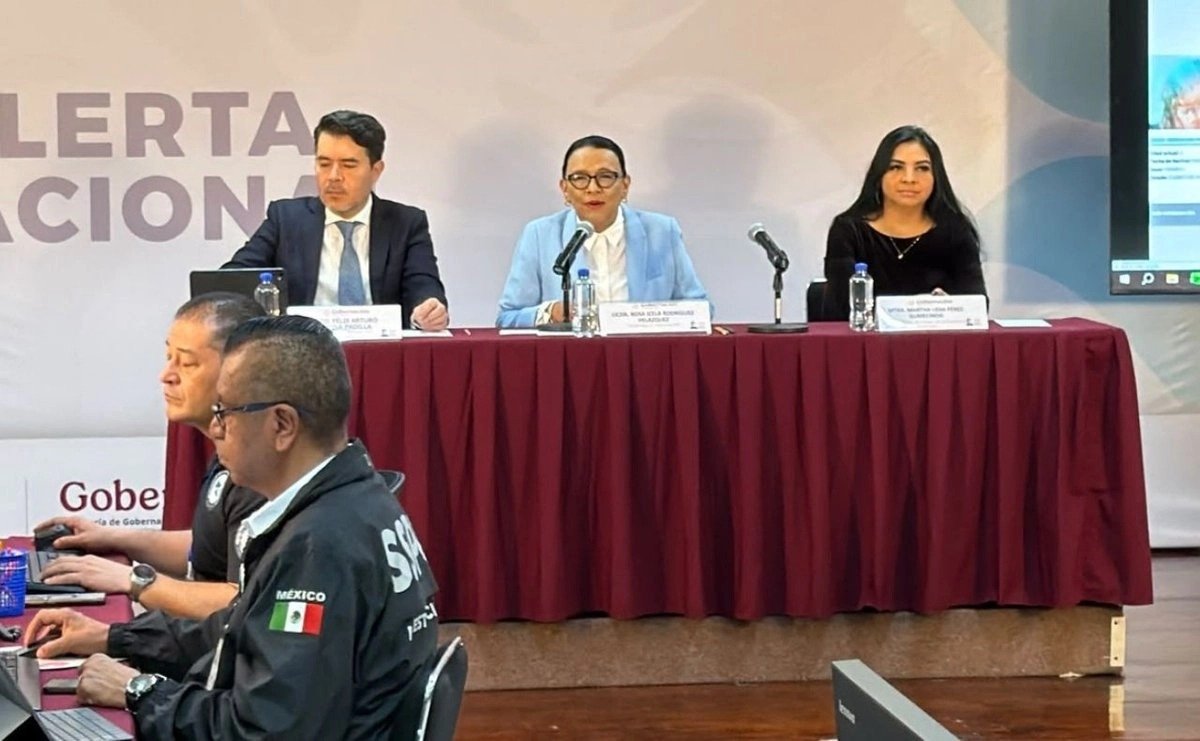
Mexico City. The Secretariat of Governance announced this Wednesday the formation of a group of independent experts, both national and international, who were contacted with the support of the Office of the United Nations High Commissioner for Human Rights in Mexico. They will be responsible for carrying out a “technical and scientific analysis” of the national registry of disappeared and missing persons, detailed the head of this Secretariat, Rosa Icela Rodríguez Velázquez.
At a press conference, together with the Undersecretary of Human Rights, Population and Migration, Arturo Medina, and the head of the National Commission for the Search of Persons, Martha Lidia Pérez, the Secretary of Governance stated that “their work will also make it possible to identify possible legal and administrative improvements so that the national registry fulfills the purpose established in the law: to be an effective tool for search and location.”
At the same time, she announced that as a result of the ten pillars established for the National Search Strategy, 16,003 people who had been reported as disappeared have been located.
It was detailed that 6,939 were located through the Single Identity Platform; 4,788 were the product of the strategy with the states; 3,473 through the National Immediate Search Alert (ANBI), and 1,214 through searches in the field.
From the ANBI command post, installed inside the headquarters of the Secretariat of Governance, Rodríguez Velázquez recalled that one of the commitments recently made by the federal government was the formation of a group of national and international specialists.
Meanwhile, Undersecretary Medina noted that, with the support of the Office of the United Nations High Commissioner for Human Rights in Mexico, they held meetings with national and international specialists in data analysis, statistics, mathematics, artificial intelligence, and other disciplines, after which they formed the working team.
He highlighted the participation of Mayank Kejriwal, a scientist at the University of Southern California, specialist in artificial intelligence, and complex systems.
Also joining will be Zubin Jelveh, a researcher at the University of Maryland, expert in data analysis and public policy evaluation, as well as Ted Enamorado, of the University of Washington, specialist in statistical and probabilistic methods for linking records and integrating databases.
He announced that a data analysis specialist from Massachusetts will soon join.
Likewise, Mexican specialists are joining this group, such as Astrid Adriana Pozos, a researcher specializing in the disappearance of persons and human identification, with experience at the International Committee of the Red Cross; Esteban Salomón, a researcher at UNAM, specialist in the functioning of prosecutors’ offices and the justice system; as well as Ernesto Insunza Vera, a researcher at the Center for Research and Higher Studies in Social Anthropology (CIESAS) in Veracruz, who is an expert in accountability and citizen participation.
At the same time, Guillermo Guevara, a specialist in security and justice public policy, is participating, as well as Rodrigo Canales, a professor at Boston University, expert in institutional strengthening, public security, and violence reduction.
“This group brings together knowledge in artificial intelligence, statistics, data analysis, public policy, justice systems, disappearance of persons, and institutional strengthening. It is a technical group that is going to help us from a specialized and scientific perspective in several tasks.”
We want them to audit us, we want them to review us, we want all the information to be transparent, and that is why today we are pleased to be able to announce that this team of national and international experts has now been formed.
Arturo Medina, Undersecretary of Human Rights
He underlined that they asked them for three fundamental tasks: to review and technically validate the methodologies being used, in order to analyze the national registry with objectivity, and from technical and scientific knowledge.
They entrusted them with establishing differentiated criteria, based on international practices, for the records that have sufficient information to carry out a search, and to detect those that require their data to be completed and those in which activity has been identified after the date of disappearance.
They must define the treatment to be given to the records that, according to the analysis that has been carried out, do not have complete or sufficient information to identify a person or to carry out a search for them.
As a third task, they were asked to propose better techniques, technical improvements, and, when necessary, legal or administrative reforms that make it possible to maintain a reliable, up-to-date registry that is an effective tool for the search for disappeared and missing persons.
-
Mexico Does Not Have the Capacity to Confront the Cartels, Trump Says
Speaking at the White House, Trump claimed without evidence that cartels control Mexico and warned they have a deadline to “basically surrender.”
-
People’s Mañanera October 15
President Sheinbaum’s daily press conference, with comments on economic growth, neoliberalism, tourism, and Jalisco.
-
Jalisco Governor Unleashes Repression – Soberanía 128
Jalisco’s crackdown on clean-water protesters, the IMSS workers’ march, Sheinbaum’s first Instagram and TikTok live, and Garduño’s exoneration over the Ciudad Juárez fire.