
It’s Time to Tax Extreme Wealth in Mexico & Latin America
This editorial by Gabriel Zucman originally appeared in the April 14, 2026 edition of La Jornada, Mexico’s premier left wing daily newspaper. The views expressed in this article are the authors’ own and do not necessarily reflect those of Mexico Solidarity Media or the Mexico Solidarity Project.
When Brazil placed taxing the ultra-wealthy on the G20 agenda in 2024, it transformed a long-postponed question into a political priority. The proposal—in which I had the honour of participating—called for a minimum effective tax rate of 2% for individuals with assets exceeding US$100 million. For the first time, the world’s leading economies jointly acknowledged that the super-rich are not paying their fair share of taxes and that it was necessary to consider ways to address the situation.
Since then, the issue has rapidly risen on the global political agenda. Countries like France, Spain, the Netherlands, Denmark, and Sweden are debating fairer taxation for the wealthy. In the United States, California may put a tax on the ultra-rich to a referendum in November, while in New York, Zohran Mamdani has proposed taxing millionaires. Brazil, for its part, recently passed a landmark tax reform for the super-rich. What seemed politically unattainable just a few years ago is now on the table as a real possibility.
This is especially important in Latin America, one of the most unequal regions in the world , along with the Middle East and North Africa. The richest 10% own around 50% of the national income, while the poorest half receives only 8%. In the last quarter of a century, the fortunes of the region’s billionaires have increased more than sixfold, reaching record highs. In Mexico, billionaires hold a combined fortune of nearly US$300 billion. If the threshold is broadened to include individuals with fortunes exceeding US$100 million, the accumulated wealth surpasses US$500 billion, more than Colombia’s total GDP.
Mexico’s tax burden, equivalent to 17.7% of GDP , is below even the regional average, and it has the lowest tax revenue among all OECD members.
This outcome is not inevitable; it is the result of political decisions. A new analysis commissioned by Brazil from the International Tax Observatory, which I direct, on behalf of the Regional Platform for Tax Cooperation in Latin America (PTLAC), shows that fiscal policy is central to this story. Throughout the region, tax systems do little to reduce inequality and, in many cases, exacerbate it. The poorest 50% of the Latin American population pays about a third of their income, mainly through consumption taxes. In contrast, the wealthiest 1% pays, on average, around 22%. This pattern is not unique to the region: in several countries, billionaires face lower effective tax rates than the rest of the population because they can structure their wealth to generate little taxable income.
That’s why a new instrument is needed: an effective minimum tax on the wealth of the super-rich. The logic is simple: since taxable income can be easily manipulated, this minimum should be defined as a fraction of wealth, which is much harder to hide. The rule would apply only to people with assets above a certain threshold, for example, $100 million.
Unlike traditional wealth taxes, a minimum tax, such as 2% on net worth, acts as a floor. If income and wealth taxes already paid do not reach that 2%, the difference will be taxed. If taxes paid reach 2%, no additional amount will be due. The proposal simply ensures that billionaires contribute, in relation to their wealth, at least as much as ordinary citizens.
In the report commissioned by Brazil, my colleagues show that a minimum 2% tax on fortunes exceeding US$100 million would raise approximately US$24 billion annually—roughly 0.6% of the GDP of the region’s seven largest economies. At a 3% rate, revenues would reach US$36 billion. In Mexico, a minimum 2% tax on the wealth of individuals with more than US$100 million could generate around US$10 billion, which could fund an expansion of public health and education services in the country.
The proposal is viable. Over the past decade, international cooperation has transformed transparency regarding global wealth. The automatic exchange of information has drastically reduced the opacity of offshore assets. Furthermore, many forms of wealth—such as real estate, publicly traded shares, and inheritances—are already declared or taxed, and the valuation methods used by private companies are widely employed in finance and tax administration.
Latin America has compelling reasons to take this debate seriously now. The region’s average tax-to-GDP ratio is 21.3%, compared to 34.1% for OECD countries. The gap is even wider in some of the region’s largest economies: Mexico’s tax burden, equivalent to 17.7% of GDP, is below even the regional average, and it has the lowest tax revenue among all OECD members. Furthermore, growth has not been sufficient, and debt service pressures are mounting. Governments need resources to invest in health, education, climate change adaptation, and productive transformation.
But they also need legitimacy. A tax system loses legitimacy when workers, teachers, and small business owners pay more, proportionally, than the very wealthy. OECD data shows that only 29% of Mexicans believe the system taxes them fairly. When economic power accumulates without a corresponding contribution to the public good, democratic institutions begin to erode.
Latin America doesn’t need to wait for perfect global coordination to take action. International cooperation is desirable, and Brazil has led the way by bringing the issue to the international stage. But the countries of the region can also make progress at the domestic and regional levels, building on the growing consensus that extreme inequality is neither inevitable nor untouchable. The proposal is new. Implementing it is within reach. What’s lacking is the political will to act.
-
Defense of Sovereignty “Is Not Rhetoric, It’s Principles,” Sheinbaum Says
Sheinbaum recalled foreign pressure on Mexico in the 19th and 20th centuries and blamed the neoliberal governments and Calderón for opening the door to U.S. influence.
-
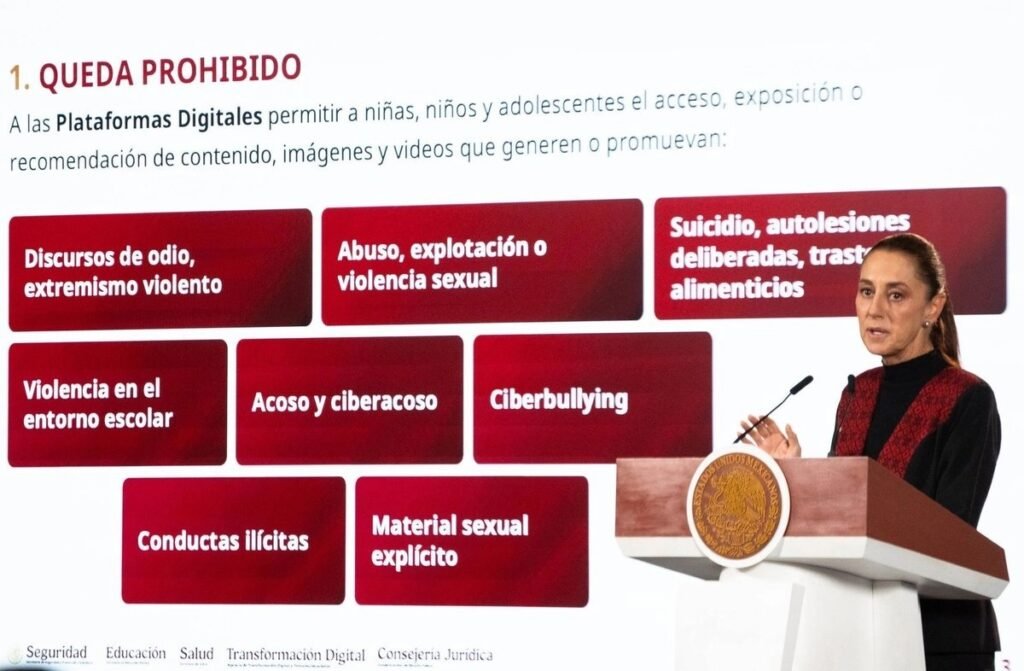
Sheinbaum Presents Draft Decree to Force Digital Platforms to Take Down Content That Incites Violence and Hate
No fines for now: the government will talk with tech companies before publishing the decree next week, a promise made after the Coahuila school attack.
-
People’s Mañanera October 9
President Sheinbaum’s daily press conference, with comments on digital safety, IMSS-Bienestar, sovereignty, and the opposition.